One of the most harmful threats to a personal house is fire. It may happen immediately due to weather conditions, electrical wires, nearby houses, or even an accidental spark. This is why such materials, which are used in the exterior decoration of a house, are important for ensuring the safety of properties and families. Fire resistant siding is one of the best ways to reduce risk.
Not only does such material withstand high temperatures better, but it also allows more time to respond in a critical situation. In this article, we shall consider the reasons why fireproof siding for houses is a sensible and cost-effective choice for a modern house.
Key benefits of fire resistant siding for your home’s safety
Fire safety is one of the most significant considerations when selecting materials for a house’s exterior cladding. Fire-resistant siding is created to minimize the chance of ignition and slow down the speed of fire spreading, which would indirectly provide more time to respond to a critical moment. For homeowners, this implies greater security for their property and the whole family.
Among the main benefits of fire resistant siding is that it cannot support combustion. These types of materials do not burn out or produce sparks or high temperatures as quickly as regular cladding solutions. This is especially important for houses in regions with a dry climate or near forest areas, where the risk of fire is higher.
The fire proof siding is also beneficial for containing the spread of flames on the facade. When the exterior walls are not involved in the propagation of the fire, the chances of the fire taking up the entire building in a short time are minimized. These additional minutes may be decisive for a successful evacuation and for the arrival of the fire services in many situations.
The other significant factor is the minimization of heat damage. The high temperatures can be better managed with fire-resistant materials, which contribute to the safety of a home’s structural components. This minimizes the chances of gross structural destruction and may facilitate easy reconstruction post a fire.
Also, besides direct protection, fire resistant siding can positively influence insurance rates. The higher a home’s fire rating, the lower its insurance rates can be, as the likelihood of high losses to the insurance company is low. This renders fire rated siding not only protective but also a very cost-efficient solution in the long run.
Finally, fire resistant house siding is an investment in tranquility. Knowing that your home is protected against one of the very worst threats provides a sense of safety, and you can go about your life in comfort and security.
Exploring different types of fireproof siding for homes
When selecting siding with greater fire resistance, one should understand how various materials react to fire. All of them are equally protectionist, yet they all find application in residential construction. The following are the key siding varieties most frequently considered for fire safety.
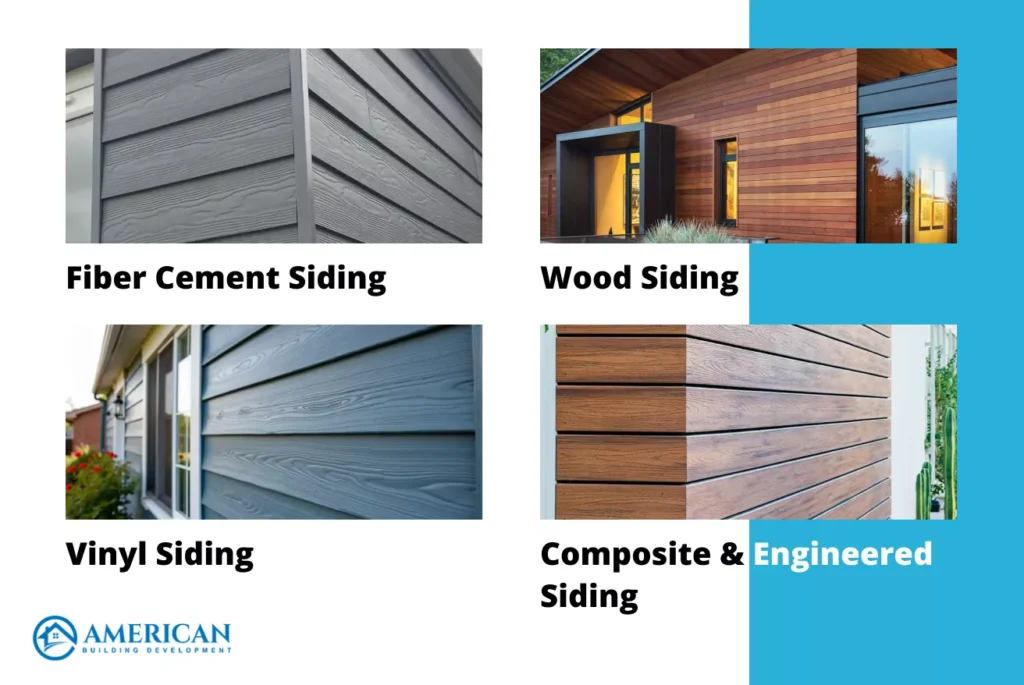
Fiber cement siding
Fiber cement siding is among the most widely used materials in the group of fire-resistant cladding. It is cast on a mineral base with fibers added, which prevents the material from sustaining combustion. This is why fiber cement can be used in houses located in areas prone to fire.
It is applied to the overall facade cladding as well as to sections where additional protection is needed.
Wood siding
Wood siding is not fireproof, yet it is still part of the comparisons due to the opportunity to treat it with special fire-retardant treatments. These coatings make the wood less flammable and reduce the rate of fire spread. Nevertheless, wood requires special care and frequent replacement of protective layers to ensure a minimum level of fire safety.
Vinyl siding
This siding is not regarded as a fire-resistant material; however, it is commonly referred to in the subject of fire safety because it is so widespread.
PVC is not made to support combustion like wood, but when heated, it may melt. This implies that the active fire protection of vinyl is not possible, but the system may be included as part of a facade when non-combustible substrates and structural solutions are employed.
Composite and engineered siding
Composite and engineered siding are made of different materials, such as wood fibers, minerals, and protective additives. The degree of fire resistance of such panels is related to their composition and production technology. There are some choices that are better fire-resistant, and others that are specially designed to meet contemporary safety needs.
Overall, fire resistant siding for homes offers varying degrees of fire protection, and the right one depends on the circumstances, the house’s location, and general safety needs.
How to install fire resistant siding for maximum protection
The finest fire resistant siding cannot provide sufficient protection when installed incorrectly. The installation will significantly enhance the facade’s fire and high-temperature resistance. That is why the installation strategy should be comprehensive and meet the suggested building standards.
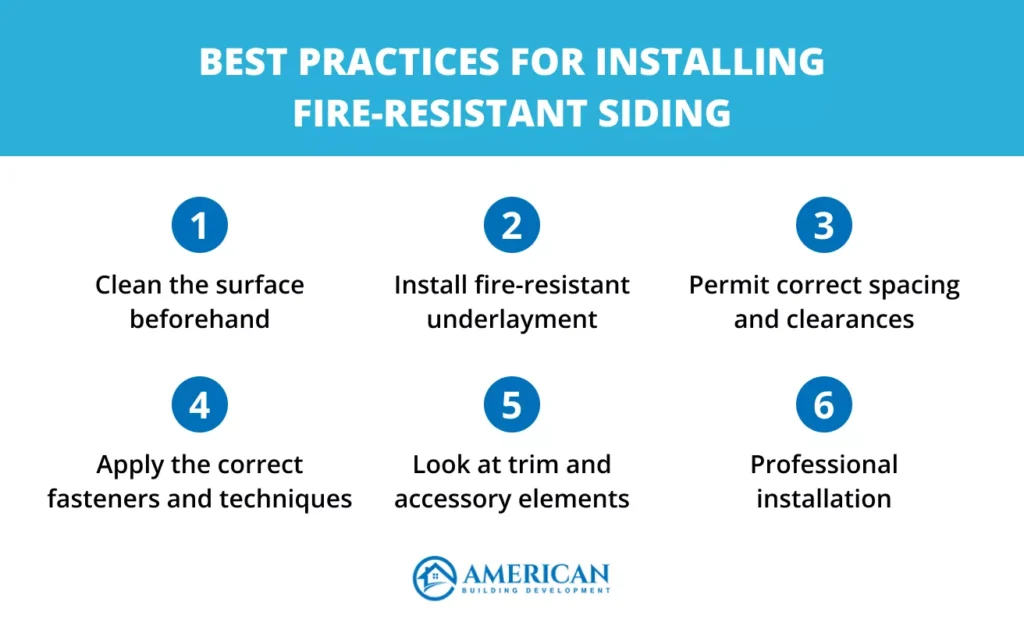
1. Clean the surface beforehand
The finest fire proof siding cannot provide sufficient protection when installed incorrectly. The first is surface preparation. The walls should be even, dry, and free of wear. Any cracks, rotten, or weak points must be removed prior to installation.
The condition of the crate or frame also needs to be checked, as it bears the greatest share of the siding’s load.
2. Install fire-resistant underlayment
The second thing is to install a fire-resistant underlay. It is also provided by a non-combustible membrane or protective coating that adds an extra layer of protection between the house’s structure and the facade coating. It helps reduce heat dispersion and minimise the risk of damaging interior walls.
The material overlap should also be in accordance with the recommendations during installation, and the joints should be firmly fixed.
3. Permit correct spacing and clearances
One will be required to leave the right gaps when attaching the panels. Temperature variations may be a response to fire retardant siding and other facade materials. Supporting the integrity of the cladding is something you have gained by avoiding deformations through compensation gaps. Special focus should be placed on corners, joints, and roundabouts of windows and doors.
4. Apply the correct fasteners and techniques
The panels are to be fixed using the right elements – nails or screws suggested by the manufacturer. The fastening must not be tight enough to prevent the material from adjusting to changes in temperature. The proper placement and number of fasteners prevent damage and provide the facade’s stability.
5. Look at trim and accessory elements
Other components, such as initial strips, final designs, and insulating sheets, are significant throughout the system. They help seal some openings and reduce the risk of flames passing through the joints or edges of the panels.
All accessories should also be compatible with the chosen siding type and possess a decent level of fire resistance.
6. Professional installation
To protect the object as much as possible, it is advisable to leave the installation to experienced professionals like our ABD team. Installation by our skilled professionals, in accordance with building codes and manufacturer specifications, ensures that fire resistant siding will serve its safety role and last as long as possible.
Common misconceptions about fire resistant siding
Despite the increased interest in fire resistant siding, many misconceptions persist about it. Through them, the homeowners are able to either overrate the material’s ability or otherwise under-rate its benefits. Knowledge of common myths would guide us to make better decisions.
Among the mythical beliefs is the belief that fireproof siding for houses is totally fire-resistant. Indeed, these materials do not render a house non-combustible. They are supposed to minimize the risk of ignition and delay the spread of fire, not to prevent the fire. Security is based on a combination of factors, including the house’s construction and the other materials used.
The other mistake that people have made is the notion that anything that does not burn does not necessarily ensure safety. The best siding will not offer suitable protection unless it is installed. Inaccurate gaps, the absence of a fireproof substrate, or breaches in installation technology can also significantly reduce the efficiency of fireproof siding for houses.
Other homeowners are of the opinion that fireproof siding is not attractive or limits design. This is an outdated idea. The number of styles, textures, and colors of materials in the present day is so extensive that they are applicable to both traditional and modern houses. Fire safety no longer means sacrificing appearance.
There is also a common misconception that fire resistant siding does not need any support. Such materials are often tougher; however, some basic care is still needed. Regular checks, cleaning, and prompt mending of minor damage are carried out to ensure the preservation of the facade’s safety features.
The high cost is another myth of its requirement. It is true that not all fire-resistant materials are cheaper, but other alternatives can be obtained at varying costs. Moreover, spending on fireproof siding is commonly offset by greater service life and a higher degree of comparative safety.
Finally, fireproof siding for houses is not a solution for all, but a significant component of overall home protection. Learning the material’s actual potential will help prevent issues and choose the appropriate option.
Conclusion
Fireproof siding is expensive in terms of appearance and in terms of protection and longevity. It helps reduce potential loss and damage and helps stop fire spread. Moreover, these materials are very durable and withstand harsh weather conditions.
If you intend to construct or upgrade your facade, our expert team will install fireproof house siding on your building, which will be a convenient option because it provides peace of mind, reliability, and assurance of the future.
FAQ
Fire resistant siding is an exterior covering composed of materials that are not easily flammable and can withstand heat. It is primarily used to slow the spread of a fire and reduce damage to the building materials of the house.
The majority of fire resistant siding types have a lifespan of decades. It can be used for 30 to 50 years, with or without maintenance, depending on the material.
Fire resistant siding exists in a wide variety of styles, textures, and colors. It can resemble the appearance of wood, stone, or contemporary panels, but offers much superior protection. Homeowners can pick from standard, modern, and personalized designs without compromising safety or curb appeal.
Numerous fire resistant siding materials are regarded as eco-friendly. It is also available in materials like metal, which is usually composed of natural or recycled materials and has a high longevity, minimizing waste in the long run.