
Exterior window trim is the board assembly that finishes a window opening and, more importantly, manages water where the window meets the siding. It fails for predictable reasons – unsealed corner joints, missing head flashing, and caulk asked to work as a permanent water barrier – not because the boards simply got old.
Style and material choices matter, but they matter differently depending on your house. A Craftsman bungalow carrying 4½-inch flat casings needs a different approach than a 1970s ranch with plain narrow boards, and a mid-century Streng property may require wood or wood-matched composite to keep its original profile intact.
This guide covers the terminology, the four main style families, five material options, and why trim rots. Let’s start with what the trim is actually doing behind the paint.
What Is Exterior Window Trim?
It’s the board assembly that wraps the outside of a window opening and bridges the gap between the window frame and the siding. From the street, it reads as decoration. Its actual job is water management at one of the most vulnerable seams on the wall.
The terminology trips people up. Window casing refers to the flat boards framing the opening on all four sides, while trim is the broader term that also takes in sills, drip caps, and backband details, according to This Old House. Window molding tends to describe the more ornamental version – wider stock with a pronounced profile – which is why window molding exterior packages on a Victorian look nothing like the plain casing on a 1970s ranch.
One more term is worth knowing: brick molding. It’s a thicker exterior casing profile, milled so siding or masonry can butt directly against it. Whatever it’s called on the invoice, exterior window casing sits at a transition point where wind-driven rain wants to get behind the wall. Every piece of exterior window trim molding either sheds that water outward or holds it against the framing. That distinction is what separates trim that lasts decades from trim replaced twice.
Once you understand what trim is doing structurally, the next question homeowners usually ask is which look fits their house.
Exterior Window Trim Styles to Know
Most of the styles fall into four families, and the quickest way to narrow down exterior window trim ideas is to match your home’s era rather than chase a look in isolation.
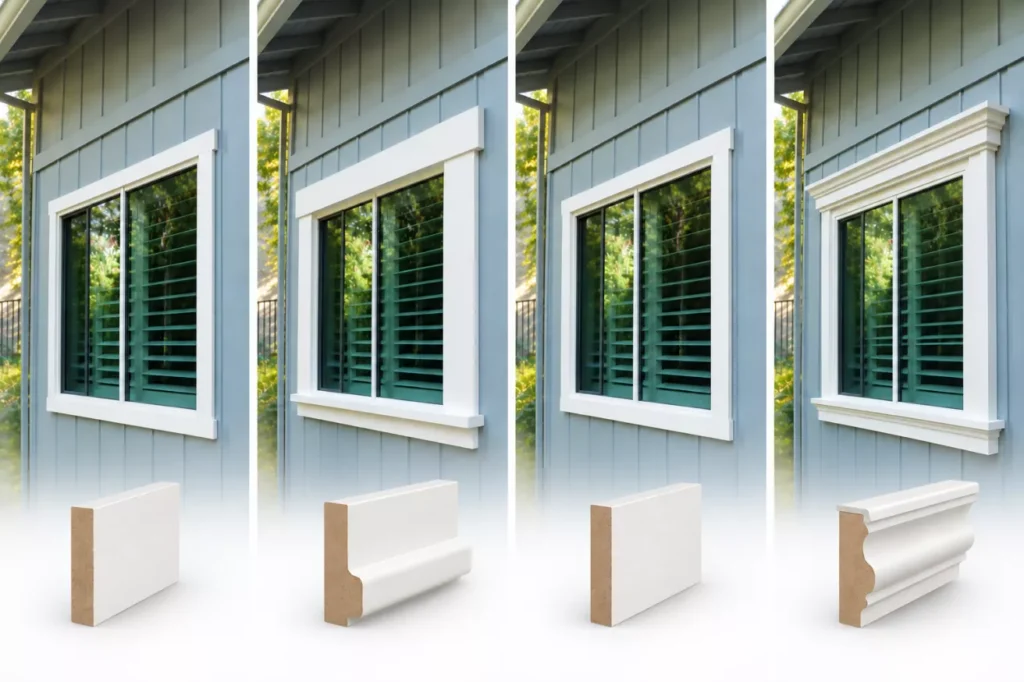
Traditional plain flat casing is the default on countless ranch, colonial, and postwar tract homes. Narrow boards, square edges, no ornament – sized to frame the opening without pulling the eye.
Craftsman and wide-band trim goes the other direction on purpose. Bungalow windows commonly carry 4½-inch or 5½-inch flat board casings with a 1¾-inch sill nose, according to Andersen Windows, and the head assembly typically runs 1.5 to 2 times the width of the side casings. Visual weight is the point.
Modern homes usually favor narrower, flat-stock profiles that keep the window surround simple and understated.
Historic and decorative exterior window trim is a category of its own: milled profiles, drip caps, corbels, sometimes two materials on one opening – stucco surrounds paired with cast stone sills on Spanish Colonial homes, for instance. Restoration work often means replicating an original profile rather than picking from a catalog.
Style is only half the decision – what that trim is actually made of determines how long it holds up.
Exterior Window Trim Materials Compared
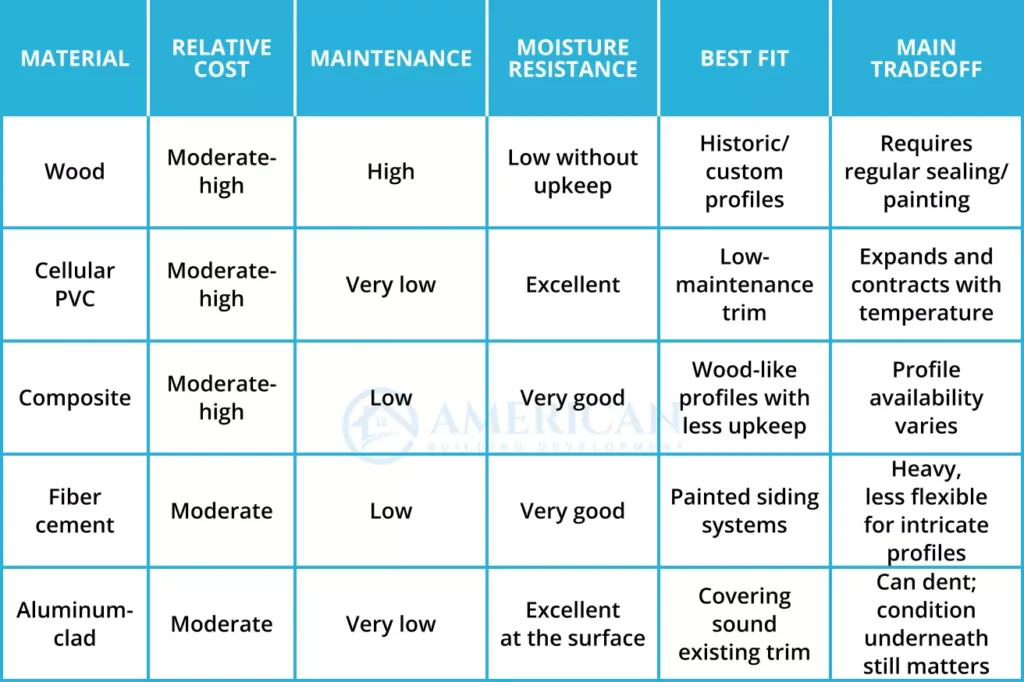
Five materials dominate. Wood window trim exterior matches historic profiles well, but unsealed end grain swells, warps, and eventually rots. PVC window trim exterior boards – cellular PVC – resist rot and insects, though thermal movement demands gapping. Vinyl window trim exterior sells alongside it.
Fiber cement resists rot, paints well, weighs more. Aluminum-clad wraps existing wood, yet dents. Composite splits the difference, while prefabricated exterior window trim kits arrive as one-piece frames, cutting ladder time.
Matching Trim on Older or Architecturally Distinct Homes
Low-maintenance material isn’t always the deciding factor. Mid-century, historic, and architect-designed homes can have casing profiles that off-the-shelf PVC or composite boards don’t reproduce well. In those cases, wood or a closely matched composite may be the better choice for preserving the original proportions.
How Exterior Window Trim Typically Fails
Trim problems usually start at joints and transitions, not in the middle of a board.
Start at the corners. Butt-jointed corners expose end grain, which drinks moisture far faster than face grain does, and once that joint opens even slightly, water wicks straight into the board and stays there. Untreated butt joints are a predictable failure point in wet climates, not a freak accident.
The second offender sits above the window. Missing or failed head flashing – or a drip cap installed without end dams – lets water run off the edge and behind the weather barrier. Damage concentrated at one opening rather than spread across the wall often points to a localized water path.
Third, caulk gets asked to do a job it was never designed for. Sealant dries, cracks, and pulls away from the wood within a few seasons. When caulk is the only thing standing between wind-driven rain and the sheathing, dry rot repair becomes a question of when.
Bubbling paint and soft, spongy trim are late symptoms. By then, the framing behind it usually needs attention too, which is why an exterior window trim replacement often uncovers dry rot damage in Sacramento homes hidden entirely from view.
Knowing where trim fails also points to what a proper installation needs to get right the first time.
Installation Principles That Prevent Early Failure
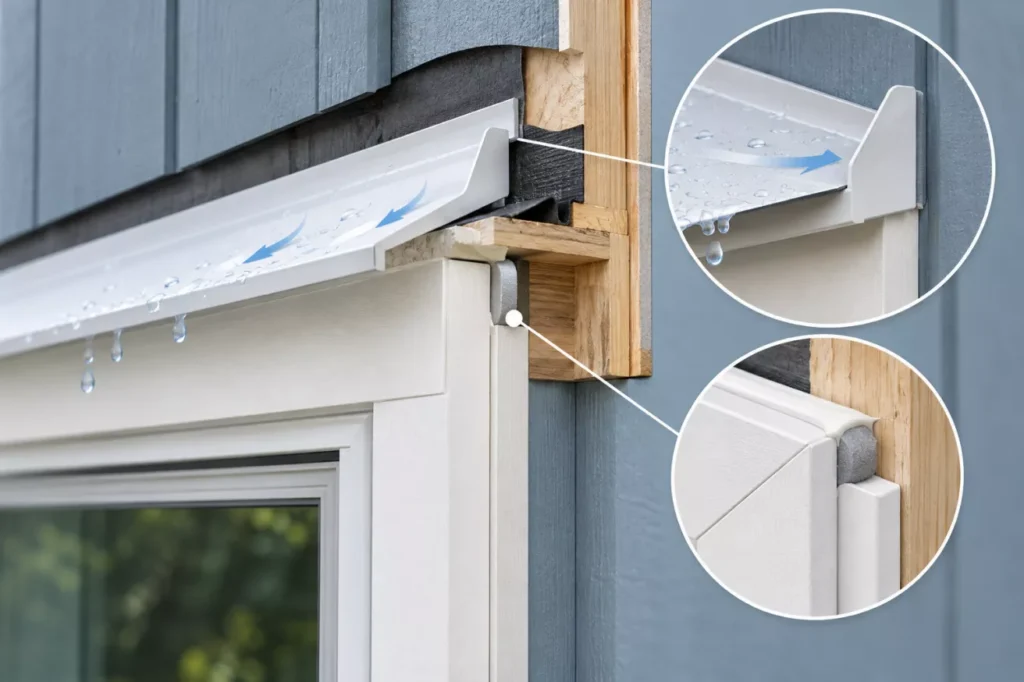
Three details have an outsized effect on how well window trim holds up over time – and none of them are especially noticeable once the job is finished.
- Head flashing: Water needs a clear path out and away from the window, not behind the trim.
- Sealed joints: Detail corners and seams for movement and water exposure instead of relying on a surface bead of caulk alone.
- Material movement: PVC, composite, wood, and fiber cement behave differently as temperatures and moisture change, so installation details need to follow the material being used.
Trim replacement often exposes the siding and flashing around the opening, so it can make sense to evaluate related siding repair at the same time. That’s the general logic behind good trim work – here’s what it actually looks like on the houses we work on.
What This Means for Your Next Trim Project
Good exterior window trim is mostly invisible work. The head flashing you’ll never see again, the sealed corner joint, the expansion gap sized for a July afternoon – those decide whether the boards look good in twenty years or need replacing in six. Style and material get the attention, but installation detail carries the outcome.
If you’re weighing options right now, start with two questions. What era is your house, and what’s the trim actually made of? Those answers narrow the field faster than browsing photos will.
Seeing how trim, siding, and flashing come together on real Sacramento-area homes tends to make the decision easier – our completed exterior projects show that overlap clearly.
For deeper background on dry rot, siding materials, and exterior maintenance timing, the exterior remodeling blog covers each topic in more detail.
If the paint around a window is bubbling or the trim feels soft when you press it, don’t wait for another rainy season to find out how far the damage goes. Get a siding estimate and have the area checked before installing new trim.
FAQ
There’s no single winner. PVC and composite generally lead on rot resistance and low maintenance, while wood remains the right choice when you need to match a historic or nonstandard profile your siding was built around.
Casing pieces cover the gap between the window frame and siding on all four sides. Install head flashing first, sloped to push water outward. Joints get mechanically sealed rather than caulked alone, with a small expansion gap for movement.
Yes. Trim replacement is independent of the window unit. Your contractor removes the damaged casing, inspects the sheathing and framing underneath for rot, then installs new trim – common when the window is sound, but the surrounding wood failed.
People use both terms interchangeably day to day. Casing specifically means the flat boards framing the opening. Trim is broader, covering casing plus drip caps, sills, and decorative header pieces.