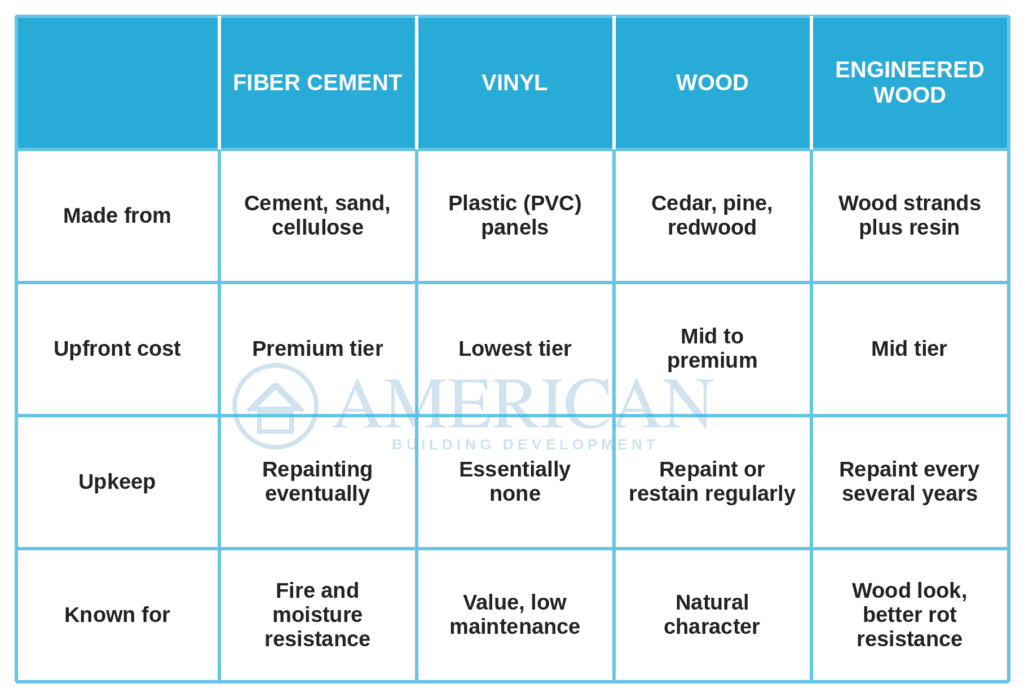
The different types of siding for homes include fiber cement, vinyl, wood, and composite or engineered wood – with metal, stucco, and brick filling out the less common end of the list. Each one trades something for something else: fiber cement demands a higher upfront cost and delivers decades of fire and moisture resistance, while vinyl keeps the budget low and upkeep near zero. Wood delivers character no manufactured product has fully copied, and engineered wood lands deliberately in between.
Installed pricing across these materials varies widely depending on material, style, and region, which explains why two bids on the same house can look nothing alike. Understanding what drives that spread – and what happens behind the boards – puts you in a far better position before the first contractor walks your property.
What Are the Main Types of Siding For Homes?
Most residential siding choices are fiber cement siding, vinyl siding, wood, or engineered wood.
Metal, stucco, and brick round out the less common types of exterior siding for homes. Metal offers long service life and a distinctly modern appearance but can show impact damage. Stucco can perform well when the wall assembly manages moisture correctly, while brick and brick veneer offer durability and minimal surface maintenance at a higher initial cost. Ask siding contractors how each behaves on your walls.
Fiber Cement Siding: Cost, Durability, And What Makes It Different
Fiber cement siding cost, installed, typically lands between $5 and $14 per square foot, with most of that spread driven by profile style, accessory packages, and installer qualifications. Labor alone often accounts for $2 to $8 of that figure – which is why the same product can be quoted very differently across two bids.
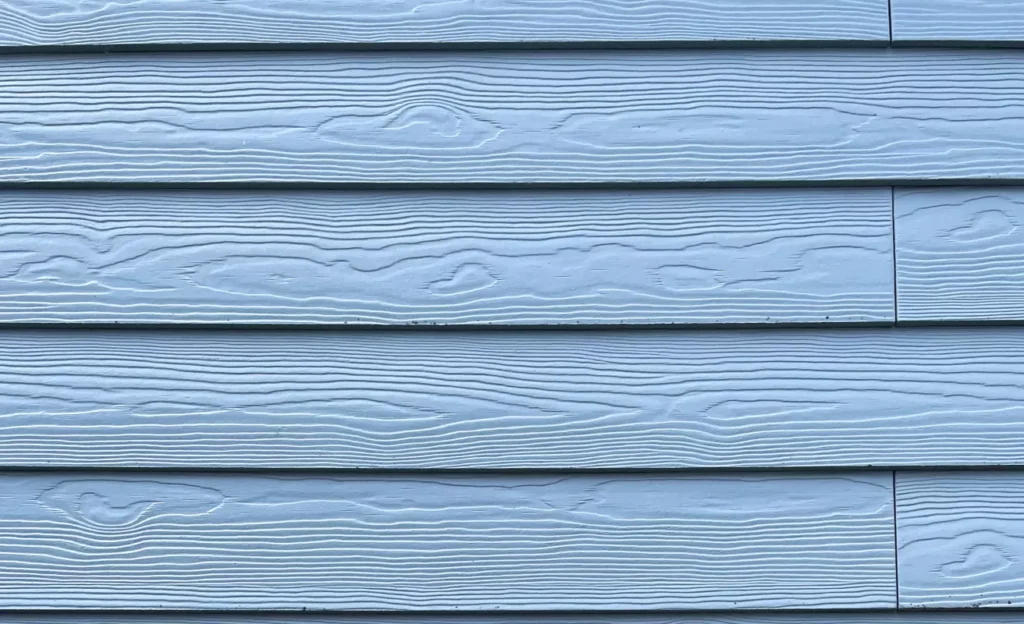
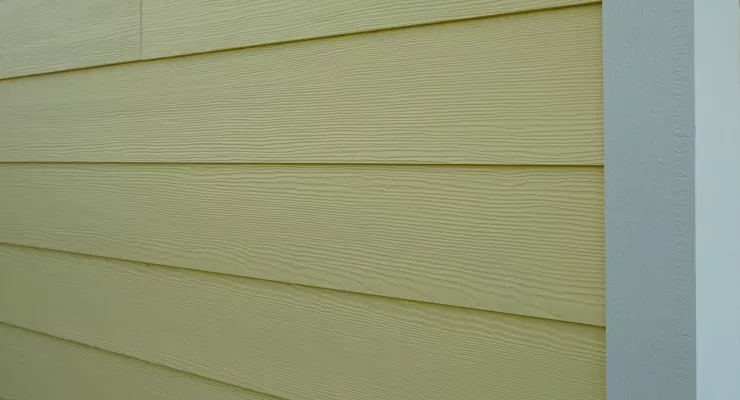
The fiber cement siding vs vinyl comparison usually comes down to how long you plan to own the house. Fiber cement is a cement, sand, and cellulose composite – dimensionally stable, so it doesn’t expand and contract the way wood and plastic panels do. Major brands back it with 30-year warranties, and properly installed walls routinely reach 40 to 50 years.
Maintenance is light but not zero. Pre-finished products like James Hardie’s ColorPlus finish go 15 or more years before repainting; unpainted board wants paint every 7 to 10 years. Twice-yearly rinsing with a hose and soft brush, plus an annual caulk check, is about the whole routine.
Proper installation and maintenance help many fiber cement installations perform well over their expected lifespan.
Where fiber cement leans expensive and durable, vinyl sits at the opposite end of the cost spectrum.
Vinyl Siding: Budget-Friendly & Low Maintenance
Installed vinyl siding generally runs $4 to $12 per square foot, with insulated panels sitting at the top of that range and basic economy-grade lap at the bottom. Panel thickness drives a lot of the spread – economy grade lands around 0.040 inches, while premium grade runs 0.048 to 0.055 inches and holds its shape far better against wind and heat.
Upkeep is about as light as siding gets. There’s no repainting cycle to plan around; an occasional wash keeps the color even.
Lifespan is where expectations need tempering a bit. According to the research, the vinyl siding lasts at least 20 years and sometimes up to 40, with high-quality products reaching 60. Harsh sun exposure, extreme temperature swings, and rushed installation all pull toward the low end of that window.
The types of vinyl siding for homes cover more ground than most homeowners expect. Double 4-inch clapboard gives a narrow, traditional reveal; Double 5-inch reads bolder and more contemporary. Dutch lap, shake, scalloped, and board-and-batten profiles are all available too.
Wood siding trades that low maintenance for architectural character, at the cost of more upkeep.
Wood Siding: Architectural Character with More Upkeep
The types of wood siding for homes have been around for centuries, and honestly, the look still hasn’t been fully duplicated. Clapboard uses tapered, overlapping boards that throw deep horizontal shadow lines. Shingles and shakes give a textured, coastal-cottage face. Board-and-batten runs vertical, with narrow battens covering the gaps between wide boards – a pattern borrowed from old barns.
Species matters more than profile for longevity. Cedar is the standard for a reason: it’s straight, resists splitting, takes stain well, and certain cedar varieties – eastern white, red, and Alaskan yellow – are naturally resistant to rot and insects. Pine costs less and needs more protection to keep up.
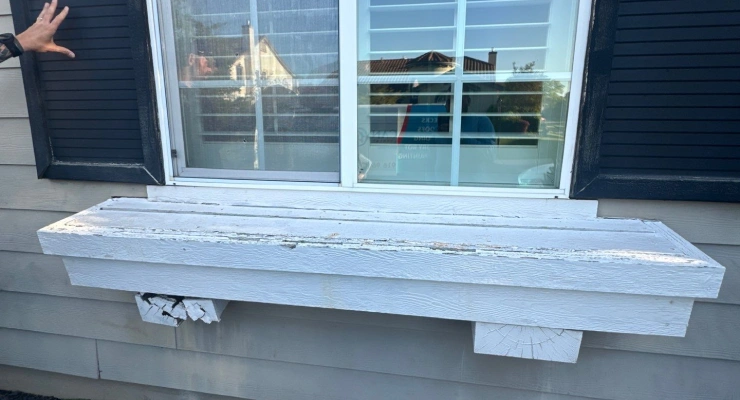
Then there’s the upkeep. Plan on repainting or restaining on a regular cycle, plus watching the spots where water lingers: window sills, lower trim, butt joints, and the bottom course.
Rot usually shows up in those specific areas rather than spreading across a whole wall, which is why targeted dry rot repair often makes more sense than tearing everything off.
Wood siding pricing varies substantially by species, profile, grade, and finish. Cedar generally costs more than pine, and labor can rise for shingles, shakes, or detailed trim work. Service life also depends heavily on moisture exposure and how consistently you maintain the finish.
Composite and engineered wood siding were developed largely to solve wood’s maintenance and rot problems.
Composite And Engineered Wood Siding: a Middle-ground Option
Engineered wood siding cost, installed, typically falls between vinyl and fiber cement. Panel style, trim package, and local labor rates account for much of the variation.
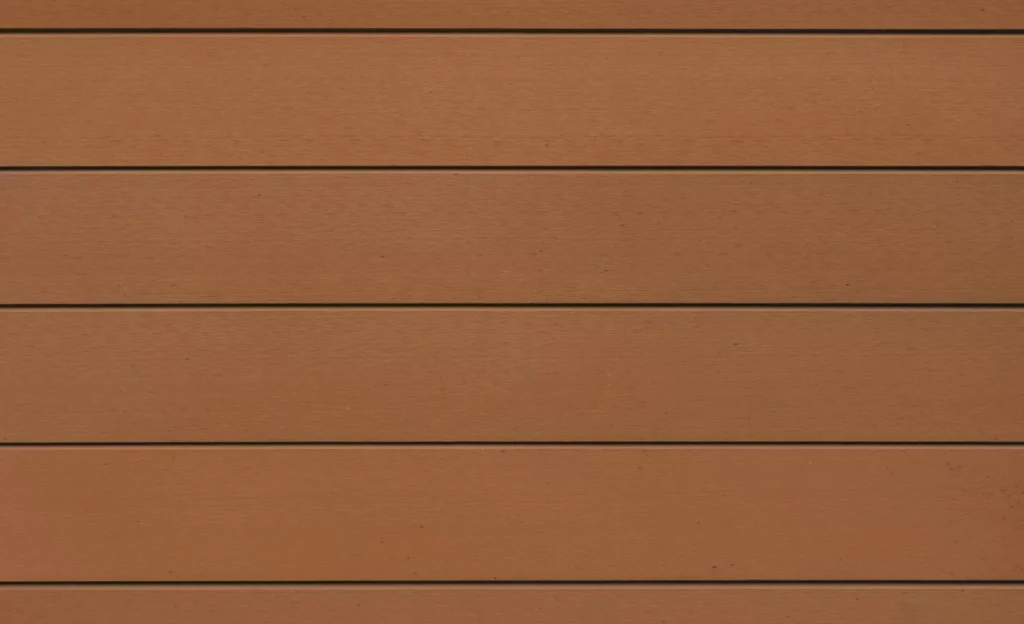
The material itself is wood strands bonded with resin and treated with zinc borate, giving it real insect and moisture resistance that solid lumber lacks. It’s lighter than fiber cement, too, so crews tend to move faster on tall walls and gables.
Expect somewhere in the range of 30 to 50 years of service. Warranties reflect that: 30-year transferable coverage is standard, some lines carry 50-year limited terms, and LP SmartSide adds a seven-year labor and replacement provision.
Maintenance sits between wood and fiber cement. Rinse annually with a hose and soft brush, skip the pressure washer, and repaint or restain every 7 to 10 years depending on sun and rainfall.
One caution before you sign anything: moisture is this product’s historic weak point, and cut edges need to be sealed the same day they’re cut. Bottom courses and unsealed field cuts cause problems years down the line.
Whichever material you choose, installation matters as much as composition.
Why Installation Quality Matters As Much As the Material You Choose
Here’s the part that rarely shows up in a siding quote: the wall assembly behind the boards decides how long they last. Flashing and moisture intrusion cause more early failures than any material defect does.
The sequence is specific. Flashing layers are under the weather barrier at the bottom and over it at the top, so water sheds outward. Reverse that at a window head or a roof-to-wall intersection, and water sits on the sheathing until rot and delamination set in.
Installer error patterns tend to follow a short list. Nails driven too tight – panels need roughly 1/32 inch of play to expand and contract. Spacing that ignores manufacturer clearances around trim and protrusions, which only reveals itself after a few seasons of temperature swings. Weather barriers with skimpy seam overlap or sloppy sealing at openings.
Watch for buckling panels, gaps, water stains near windows, and visible nail heads – those are signs siding repair services are already overdue. When comparing contractors, ask how they handle window flashing, roof-to-wall intersections, manufacturer clearances, and damaged sheathing discovered after tear-off.
With material and installation in mind, here’s how to compare the types of siding materials for homes and narrow down the right choice.
How to Choose the Right Siding for Your Home
Five factors narrow the types of siding for homes worth considering: exposure, budget, style, upkeep, and timeline.
- Exposure. Consider intense sun, wind-driven rain, wildfire exposure, shade, and areas where walls stay damp.
- Budget. Compare installed price rather than material price alone. Trim, tear-off, repairs, access, and wall complexity can materially change the total.
- Style. Consider the home’s architecture as well as plank orientation, reveal width, texture, and trim.
- Upkeep. Be realistic about whether you are willing to repaint, restain, inspect joints, or clean the exterior regularly.
- Timeline. A homeowner expecting to stay for decades may evaluate upfront cost differently from someone planning to sell within several years.
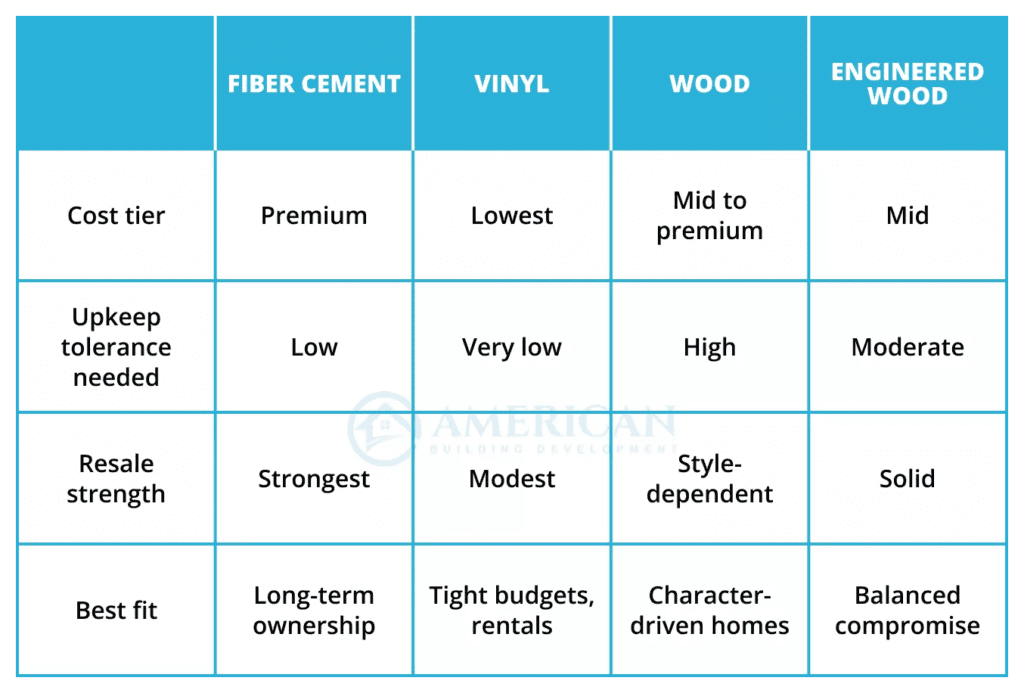
Compare types of house siding and cost across the years you plan to own the home.
Modern exterior siding options increasingly mix profiles and materials – for example, vertical board-and-batten on gables with horizontal lap siding on the main walls, or siding paired with masonry accents. The right combination should still match the house’s proportions and architectural style.
When comparing types of siding on older homes, first determine whether the existing material is repairable and whether moisture damage is localized. Targeted wood siding rot repair can make more sense than full replacement when most of the original siding remains sound.
What We See Replacing Siding on Sacramento-area Homes
Sacramento’s climate is hard on wall assemblies in a specific way. Long, dry, high-heat summers bake caulk joints brittle and open gaps at trim and butt seams. Then winter rain arrives and finds every one of them.
When crews open up a wall for a re-side, the damage rarely traces back to the siding material itself. It’s a window head with no flashing, a kick-out missing at the roof-to-wall intersection, or house wrap lapped the wrong direction. Water gets behind the boards, sits on the sheathing through a wet stretch, and the rot shows up years later as a soft spot near the foundation or under a sill.
That pattern holds across vinyl, wood, and fiber cement alike. Missed flashing, the wrong fasteners, and trapped moisture cause far more siding failures than material choice does.
You can see how the details get handled on this James Hardie siding replacement project in Sacramento.
So when you’re comparing bids, ask each contractor what happens behind the boards. Their answer tells you more than the material line item does.
Wrapping Up
Choosing among the types of siding for homes comes down to a handful of honest questions: How long do you plan to stay? How much upkeep will you actually do? What does your wall exposure demand?
Fiber cement earns its premium on long-term ownership. Vinyl makes sense when budget comes first, and you have little time for maintenance. Wood rewards homeowners who love the look enough to keep up with it, and engineered wood splits that difference reasonably well.
What matters just as much is who installs it. Flashing sequence, fastener tension, and clearance spacing determine whether your siding reaches its warranty years or fails early – and none of that appears in a per-square-foot number. Ask about it before you sign.
If you want to see how these decisions play out on real homes, the finished work in our project portfolio shows the details that matter behind the boards. More material comparisons and exterior maintenance guidance live on the ABD blog if you’re still weighing options.
FAQ
There’s no single best answer – it depends on your climate, budget, and maintenance tolerance. Fiber cement offers the strongest mix of durability and resale value. Vinyl wins on budget, wood on character, and engineered wood splits the difference.
Fiber cement, vinyl, wood (clapboard, shingle, or board and batten), and engineered or composite wood cover most installations. Metal, stucco, and brick round out the list as less common alternatives.
Fiber cement generally outperforms vinyl on durability, fire resistance, and impact resistance, at a higher cost. Engineered wood gives a more natural look with better rot resistance for a moderate price bump. Vinyl still wins on upfront cost.
It’s usually marketed as board and batten or vertical panel siding. You’ll find it in fiber cement, engineered wood, and metal versions for modern farmhouse or contemporary looks. Functionally, it’s the same idea as traditional board and batten.
Vinyl typically runs about $4–$12 per square foot installed, while fiber cement is about $5–$14. Engineered wood generally falls between vinyl and fiber cement in installed cost. Your actual cost shifts with region, home complexity, and who does the work.